Tuesday, April 7, 2015

Making Global Connections in the Classroom (Week 10, 11, 12)

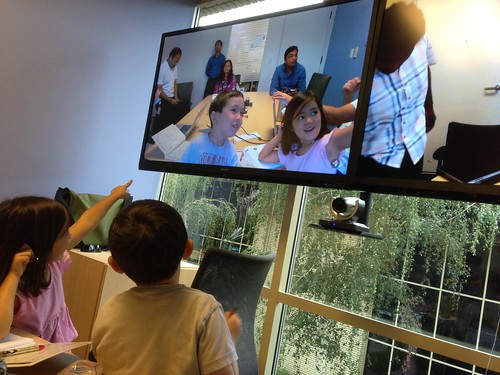
“Today’s children are ‘growing up digital,’” (Metiri Group, 2003, p.6), and educators right along side them.  The rate at which access to technology is growing is unprecedented, as stated by the Metiri Group (2003) which has the potential to alter the way we teach and what we teach. Educators are facing a challenge of knowing what tools are available and how they may apply them to curricular learning activities. Student engagement, civic responsibility, and technology's impact on global issues unfolds an amazing opportunity to incorporate unique experiences that technology may provide. Connecting citizens across the globe on issues that affect us all is a powerful learning source. One that has revolutionized classrooms in the speed and distance which children can connect to others. The collaborative and participatory nature of technology allows us to be able to ask questions, develop solutions and achieve common goals that weren't possible before. 


Yet, the tool isn't what makes the lesson meaningful or engaging. Technology is the vehicle that allows us the opportunity to learn, connect and collaborate and calls for a “...transformation of schools and classrooms into places of effective teaching and deep learning,” (Dunleavy & Milton, 2010, p.6). The pedagogy and purpose for learning, along with excitement and authenticity are what make the learning engaging. “Effective technology integration for pedagogy around specific subject matter requires developing sensitivity to the dynamic, transactional relationship between these components of knowledge situated in unique contexts,” (Koehler, 2006). Establishing the learning goal and method of delivery, along with rich opportunities for global connections are key to enhancing civic responsibility in students and increasing positive participation.


ReferencesDunleavy, J. & Milton, P. (2010). Student Engagement for Effective Teaching and Deep Learning. Canadian Education Association, 48(5), 4-8.


Koehler, M. (2006). TPACK.ORG. Tpack.org. Retrieved 7 April 2015, from http://www.tpack.org/

Metiri Group (2003). enGauge 21st Century Skills: Literacy in the Digital Age. 1-88

Thursday, March 19, 2015

Technology Differentiates Learning (Week 7, 8, 9)

Connecting the critical components of the past three weeks of course readings and discussions has confirmed the positive role technology can have in today’s classrooms. Learning environments are evolving to include a variety of instructional and assistive technologies that have the potential to develop students who are “...engaged, ethical and entrepreneurial,” (Crichton, Pegler, & White, 2012, p. 25). Differentiated instruction is an important instructional framework that varies the methods in which teachers plan and deliver instruction (Milman, 2009). Tomlinson (2013) defines differentiated instruction as “...an approach to teaching that advocates active planning for student differences in classrooms.” Technology is one tool that can support this approach to instruction in a variety of school settings.  Assistive technologies for student who need them and students who prefer to use them may reduce obstacles to learning and increase student engagement. Instructional technologies provide alternatives to expression that are motivating due to their interactive and “authentic” nature.

The amount of information, creativity and support available to students today is literally at their fingertips. Social media, BYOD, 1:1 device projects, web apps and extensions are tools of today that facilitate differentiated instruction and push learning to a new level. Teachers need time and resources to explore the possibilities and determine the relationship between what Mishra and Koehler (2006) call TPACK - Technology, Pedagogy and Content Knowledge.  Most important to the successful, proactive implementation is a team approach to identify the various factors that need to be addressed. This process requires “...extensive planning, communication, and ongoing evaluation,” (K-12 Blueprint, 2015). Having a clear understanding of the process, challenges and goals is essential to implementing a technology rich learning environment. 

References

Crichton S, Pegler K, White D. Personal Devices in Public Settings: Lessons Learned From an iPod Touch / iPad Project. Electronic Journal Of E-Learning [serial online]. March 2012;10(1):23-31.

K-12 Blueprint,. (2015). Bring Your Own Device Toolkit. Retrieved 20 March 2015, from http://www.k12blueprint.ca/byod

Milman, N. B. (2009). Differentiating instruction in online environments. Distance Learning. (6)3, 87-89.

Mishra & Koehler (2006). Technological pedagogical content knowledge: A framework for teacher knowledge. Teachers College Record, 108(6), 1017-1054.

Tomlinson, C. (2013). Fulfilling the Promise of Differentiation. caroltomlinson.com. Retrieved 20 March 2015, from http://www.caroltomlinson.com/

Thursday, February 26, 2015

Applying the Code of Professional Conduct to the Online Environment (Week 5/6)

As a user of social media, I enjoy posting, tweeting and adding pictures to my Facebook, Twitter and Instagram accounts. I reserve the right to accept “friends” and refrain from accepting parents and students within these digital platforms. I understand my responsibility as an educator to maintain a level of professionalism in and out of the work environment. I have read the Alberta Teacher’s Association Code of Professional Conduct and understand I have an ethical responsibility to act “in a manner which maintains the honour and dignity of the profession,” (Teachers.ab.ca, 2004). How does this apply to the online environment? Looking through my Facebook pictures there are a few that I would question and reconsider, but I tend to be a bit on the conservative side. Looking through colleagues pictures, my pictures would be considered very tame. When it comes to actual posts, I, unlike some colleagues refrain from posting anything negative relating to my profession, district and students. So, what is considered inappropriate content to post/share? Who determines what is considered unethical content?

Stories of teachers losing their jobs for inappropriate online activity are becoming common place. According to the College of Education in Austin Texas, teachers have been fired for posting inappropriate pictures and writing negative comments about students (Community.edb.utexas.edu, 2013). Caregiver Lindsey Stone was fired for posting a picture that was considered offensive to many people, in particular military personnel (Ronson, 2015). These are examples that I feel are reasonable terms for dismissal, but if they are continually occurring, are teachers unaware of expectations online? With the changing landscape of technology and privacy, an update to the Code of Professional Conduct to include online environments may be worth consideration. Rather than a reactive approach, districts and teacher’s unions should develop a proactive document to support educators in understanding what is considered appropriate and inappropriate online sharing.  


References
Community.edb.utexas.edu,. (2013). Why are teachers getting into trouble? | Social Media Professionalism for Teachers. Retrieved 27 February 2015, from http://community.edb.utexas.edu/socialmedia/node/61


Ronson, J. (2015). 'Overnight, everything I loved was gone': the internet shaming of Lindsey Stone.the Guardian. Retrieved 27 February 2015, from http://www.theguardian.com/technology/2015/feb/21/internet-shaming-lindsey-stone-jon-ronson

Teachers.ab.ca,. (2004). Code of Professional Conduct. Retrieved 27 February 2015, from http://www.teachers.ab.ca/About%20the%20ATA/UpholdingProfessionalStandards/ProfessionalConduct/Pages/CodeofProfessionalConduct.aspx

Image
Albertalandlord.org,. (2015). Retrieved 27 February 2015, from http://www.albertalandlord.org/images/ethics.jpg

Thursday, February 5, 2015

Worries and Wonders Online (EDER 679.33 Blog Post #4)

The readings and discussions have once again given me much food for thought. Yet, I don’t feel I am any closer to answers. In fact, I have many more questions that leave me wondering and worrying about the impact online access is having on our students and the long term effects.

The article by Harste and Albers (2012) had me thinking about my role as an AT consultant and the message I have been delivering to teachers in regards to online advertisements. Often in my workshops when I am demonstrating online tools, a website that I select may have an advertisement for a product or game. My solution has been to install an online tool, such as Adblock that recognizes advertisements on a page and removes them so that the user does not see the ad. This is usually the suggestion I give to teachers when asked how to stop these pop up advertisements from displaying on a student’s screen as they can be distracting and sometimes inappropriate. However, after reading the article, I have started to think about my patchwork solution as not good enough. Putting a bandaid on an open wound won’t solve the problem. Clear boundaries and discussion about media advertisements and images are essential to help students develop critical thinking and analysis skills.

How do skills associated with critical examination of advertisements transfer to critical analysis of other media texts?  Harste and Albers (2012) claim that instruction around visual media images is necessary in a literacy curriculum. The activities conducted in the Harste and Albers (2012) study provide students with opportunities to think and look critically as a consumer and as a marketer. A quick google search led to numerous lesson plans on marketing and consumerism. Yet I wonder about the responsibility of parents too. Whose role is it to lead students in understanding online consumerism and targeted advertisements, educators or parents? I believe a partnership is necessary to spread a common message. Unfortunately, I have friends that allow their children to install apps on iPads and iPhones. Children who have made in app purchases that add up to a large sum of money. Parents who have laptops and TV’s in their children's bedrooms or in the basement away from adult monitoring. It makes it difficult for educators to teach students about consumerism and online safety if parents are not monitoring what their children are seeing, hearing and reading.

References

Getadblock.com,. (2015). AdBlock. Retrieved 5 February 2015, from https://getadblock.com/

Harste, J.C., and Albers, P.  (2013). "I'm riskin' it":  teachers take on consumerism. Journal of Adolescent & Adult Literacy, 56(5), 381-390.

Wednesday, January 28, 2015

Potatoes and the Power of a Text Message (EDER 679.33 Blog Post #3)

To claim one method of learning more valuable than another is like saying there’s only one right way to cook a potato. But we know that there are many ways to cook a potato, from mashed to scalloped to baked to fried, it all depends on preference.

In education the same theory can be applied to learners. Theoretical frameworks have been researched, developed and implemented to meet the needs of a wide variety of learners. Differentiated Instruction (DI) and Universal Design for Learning (UDL) are two such frameworks that explore flexible teaching methods to ensure the learning preferences of students are met. Stanford and Reeves are proponents of DI because “...one style of teaching will not accommodate every student,” (2009, p. 3). The UDL framework ensures that resources, methods and strategies based on multiple means of representation, action and expression, and engagement are developed and used to meet the educational needs of all students (Brand, Favazza, and Dalton, 2012).  Not everyone is going to cook the potato in the same way.

Post secondary institutions are doing a good job in many cases of offering students programming options,  knowing that the needs of their students differ. Both face to face and online sessions provide learners with choices in terms of environment that can promote and enhance their learning experience. As a student enrolled in online graduate studies, I see the advantages and disadvantages of this type of programming. For some, the lack of connectedness and face to face dialogue can be disengaging for students. Although discussion boards and chat rooms allow participants interact with their peers, the immediate feedback and limited personal connection may affect academic results and engagement. One disadvantage of asynchronous instruction discovered by Murphy, Rodriguez-Manzanares & Barbour (2010) was a higher dropout rate than the synchronous environment. Could this be a mismatch in learning style and instructional method? Or could it be due to the  lack of personal connection? I recently came across the article Helping the Poor in Education: The Power of a Simple Nudge, by Susan Dynarski that speaks of the power of a text message. A study of low income high school students who received text messages reminding them of their college application deadlines, were more likely to follow through with their application. Another group of college students also received text messages while enrolled in college courses. The results revealed that fewer students who received the text messages dropped out than those who had not received text messages.  Would text messaging help students in asynchronous settings feel more connect? Knowing that someone cares about your participation or can guide you in meeting deadlines, could this help with retention and dropout rates? Can this be applied to a classroom setting for students who miss a great deal of school or those who struggle to complete assignments on time? Does the text message help students be accountable?

References

Dynarski, S. (2015). Helping the Poor in Education: The Power of a Simple Nudge. Nytimes.com. Retrieved 28 January 2015, from http://www.nytimes.com/2015/01/18/upshot/helping-the-poor-in-higher-education-the-power-of-a-simple-nudge.html?hp&action=click&pgtype=Homepage&module=mini-moth&region=top-stories-below&WT.nav=top-stories-below&abt=0002&abg=0

Murphy, E., Rodríguez-Manzanares, M. A., & Barbour, M. (2011). Asynchronous and synchronous online teaching: Perspectives of Canadian high school distance education teachers. British Journal Of Educational Technology, 42(4), 583-591.


Stanford, B., & Reeves, S. (2009). Making It Happen: Using Differentiated Instruction, Retrofit Framework, and Universal Design for Learning. Teaching Exceptional Children Plus, 5(6), 3.

Trostle Brand, S., Favazza, A., & Dalton, E. (2012). Universal Design for Learning: A Blueprint for Success for All Learners. Kappa Delta Pi Record, 48(3), 134-139. doi:10.1080/00228958.2012.707506

Wednesday, January 21, 2015

Access, Expertise, Importance & Coordination: Keys to Understanding Copyright (EDER 679.33 Blog Week 2)

“Copyright” is a scary and confusing word. One that is often misunderstood due to legal jargon, complicated amendments and clauses, and the potential to quite simply break the law. In fact, after reading and viewing the resources from this week’s topic, I’m not sure that I have a clearer understanding of the topic. How can the issue of copyright become one that is transparent to educators and that they feel they have a good grasp of?


Horava (2010) found four factors that affect the level of copyright awareness and application at the university level. They include access, expertise, importance and a coordinated approach to impact how copyright is perceived and portrayed. In addition, advantages to having an identified copyright officer or librarian to provide guidance and instruction was determined. This model is transferable to a school setting and can impact the knowledge and understanding of copyright laws as they apply to educators and students. Teachers need access to resources, such as Copyright Matters, along with a designated support person to reduce the “fear” and clarify questions surrounding the topic. Could monthly staff meetings include a brief presentation or address a new clause or amendment? Would these measures be enough for teachers to have a clearer understanding of how copyright applies to their lessons and instruction?


References
CMEC (2012). Copyright matters. Retrived from http://www.cmec.ca/139/Programs-and-Initiatives/Copyright/Overview/index.html

Horava, T. (2010). Copyright communication in Canadian academic libraries: a national survey. Canadian Journal of Information & Library Sciences, 34(1), 1-38.


Wednesday, January 14, 2015

We're All in this Together (EDER 679.33 Blog Post #1)

Technology has been a part of my education plan since I began teaching 16 years ago. In the beginning, it was simple. Each teacher booked the lab for one block a week where students would use word processing software to type their essays or paragraphs. Eventually, students began to create powerpoint presentations and maybe added clip art too. Over time, I began to explore alternate modes of representation. I used videos and animations to enhance instruction which in turn increased student interest and engagement. Within the last 7 years, I really began to look at the potential that technology offered students to both create and consume. I empowered my students to find digital resources related to the subjects we were learning to share with the class. Unlike Ohler’s (2011) suggestion that students lead two different lives when it comes to the approach many school’s take in regards to using technology, my students were plugged in both at school and at home. Yet, among this usage and exploration there was little digital citizenship instruction. Aside from my daily speech, “Only go to websites I had approved” and “The district can see who is doing what”, further digital awareness was not provided. I think many teachers were and still are in the same boat I was - without direction or an implementation plan, teachers are left to implement technology as they see fit.


Instead a more proactive, in depth digital citizenship plan is needed for our students. One that includes all stakeholders in the development. Hollandsworth, Downey & Donovan (2011) propose that the responsibility to educate students on issues of digital citizenry includes the parents, teachers, administrators and media specialists. Each partner has a role and responsibility in preparing students for their involvement in a digital society.


As my role has changed in the last three years, I find teachers and parents look to me for support and guidance as they implement assistive technology in the classroom and at home.  Does a formal plan need to be developed and added to the curriculum? Will this be the approach necessary to hold teachers accountable? What about the role of the parent? How do we provide parents with the necessary tools to help their children navigate the diversity of technology today?

References
Hollandsworth, R., Dowdy, L., & Donovan, J. (2011). Digital Citizenship in K-12: It Takes a Village. Techtrends: Linking Research And Practice To Improve Learning, 55(4), 37-47.

Ohler, J. (2011). Digital Citizenship Means Character Education for the Digital Age. Kappa Delta Pi Record, 48(1), 25-27